
The Business Case for Headless CMS: Flexibility, Speed, and Scalability
Introduction: The Website Problem Nobody Talks About
You’ve probably been there. Your marketing team wants to launch a new campaign now. Your sales team needs specific content on the website yesterday. Meanwhile, your development team is stuck rebuilding entire sections just to make simple updates. And here’s the kicker… your competitors are somehow getting their content out faster, looking better across every device, and adapting to new platforms like it’s nothing. The culprit? Your traditional CMS is holding you back.
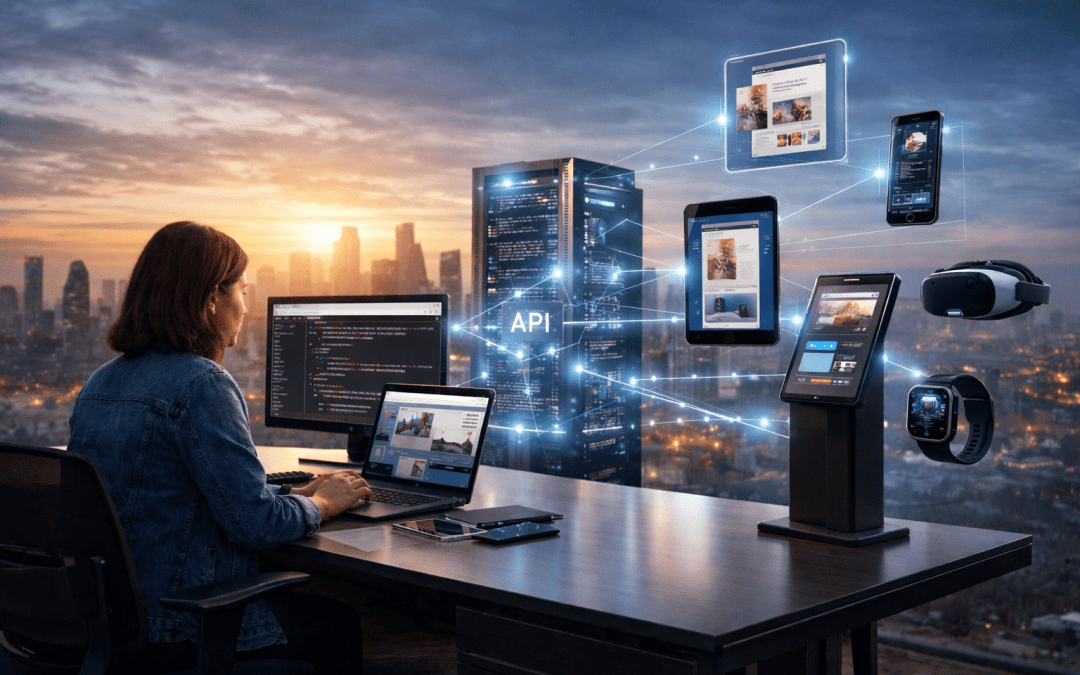
Headless CMS business benefits are transforming how forward-thinking companies manage their digital presence. Unlike traditional content management systems that tie your content to a specific website design, a headless CMS separates your content from how it’s displayed. Think of it like this: instead of building a new kitchen every time you want to change the menu, you’ve got one incredible kitchen that can serve any restaurant you dream up.
The Real Impact of Your Current System
Let’s be honest about what’s happening right now.
Every time you want to update your website, you’re probably dealing with:
- Slow development cycles that take weeks when they should take days
- Inconsistent content across your website, mobile app, and other digital channels
- Frustrated teams because simple changes require developer intervention
- Lost opportunities because you can’t move fast enough to capitalize on trends
According to a 2023 study by Forrester Research, companies using traditional CMS platforms take an average of 4-6 weeks to implement significant changes, while those using headless CMS solutions reduce that time to 1-2 weeks (Forrester, 2023).
Here’s what that actually costs you. While you’re waiting on development, your competitor is testing three different campaigns. They’re learning what works. They’re adapting. And you? You’re still waiting for IT to finish that “simple” update.
Understanding Headless CMS Business Benefits
So what makes a headless CMS different?
Flexibility That Actually Matters
With a headless CMS, your content lives independently from your presentation layer. That means the same content can flow seamlessly to your website, mobile app, smartwatch, digital kiosk, or whatever comes next. You’re not rebuilding everything from scratch each time technology evolves.
One coffee shop chain in Portland discovered this firsthand. They started with a website. Then added a mobile ordering app. Then introduced kiosks in their stores. With their old system, each platform was a separate nightmare. After switching to a headless CMS? They managed all their content from one place (Digital Commerce 360, 2023).
Speed That Changes Everything
Remember those 4-6 week development cycles? Gone.
A headless CMS separates your content management from your front-end development. Your marketing team can update content without touching code. Your developers can rebuild the front-end without disrupting content. Everyone works faster because nobody’s waiting on anyone else.
Headless CMS Scalability for Growth
Here’s where things get really interesting.
As your business grows, your traditional CMS becomes a bottleneck. More traffic? Slower performance. More content? Harder to manage. More channels? Complete chaos.
A headless CMS scales differently. Because content is delivered through APIs (think of them as content delivery highways), you can handle massive traffic spikes without breaking a sweat. When a mid-sized retailer in Ohio went viral during Black Friday 2022, their headless CMS handled a 400% traffic increase without any performance degradation (Internet Retailer, 2023).
Why Headless CMS Makes Business Sense
Let’s talk money… because that’s what really matters.
Lower Long-Term Costs
Yes, migrating to a headless CMS requires an initial investment. But consider what you’re spending now on:
- Redundant development work for each platform
- Emergency fixes when things break
- Lost revenue during slow update cycles
- Maintaining multiple systems that don’t talk to each other
Gartner research shows that companies implementing headless CMS solutions see an average 30% reduction in content management costs within the first 18 months (Gartner, 2023).
Better Customer Experiences
Your customers don’t care about your CMS. They care about getting information quickly, regardless of how they access it.
A headless architecture means faster load times (because you’re not loading unnecessary bloat), consistent experiences across devices (because it’s the same content everywhere), and the ability to meet customers wherever they are.
Future-Proof Technology
Nobody knows what the next big platform will be. Maybe it’s VR storefronts. Maybe it’s AI-powered voice shopping. Maybe it’s something we haven’t imagined yet.
With a traditional CMS, you’re locked in. With a headless CMS? You’re ready for whatever comes next. Your content is platform-agnostic, sitting there ready to be delivered to any new channel without a complete rebuild.
Making the Transition to Headless CMS
I know what you’re thinking. “This sounds great, but how do I actually make this happen without disrupting my entire business?”
Fair question.
Start Small
You don’t have to rip out everything at once. Many successful implementations start with a single use case; maybe your blog, or a new mobile app. Prove the concept. Learn the system. Then expand.
Choose the Right Partner
This isn’t a DIY project (unless you’ve got a seriously experienced development team). You need partners who understand both the technology AND your business needs. Look for developers who can translate headless CMS business benefits into actual solutions for your specific challenges.
Plan for the Learning Curve
Your team will need training. Your workflows will change. That’s not a bug! It’s a feature. Those changes are what unlock the speed and flexibility you’re after.
The Bottom Line on Headless CMS Scalability
Here’s the thing about technology decisions… they’re really business decisions in disguise.
The question isn’t whether headless CMS is cool (it is) or cutting-edge (it definitely is). The question is: what’s it costing you to stay where you are?
Every day your competitors are moving faster. Adapting quicker. Serving customers better. And every day your traditional CMS is making that harder for you to compete.
A headless CMS won’t solve every business challenge. But if you’re struggling with slow content updates, inconsistent multi-channel experiences, or the inability to adapt quickly to market changes… it might just be the competitive advantage you’ve been looking for.
Ready to Modernize Your Digital Presence?
We get it. Changing your content management system feels like a massive undertaking. But what if we told you it doesn’t have to be?
At our core, we specialize in helping businesses like yours navigate these transitions smoothly. From custom development to API solutions to full e-commerce implementations, we’ve helped dozens of companies unlock the headless CMS business benefits without the headaches.
Let’s talk about your specific situation. No sales pitch. Just an honest conversation about whether a headless CMS makes sense for your business, and if so, what the smartest path forward looks like.
Contact us today for a free consultation. Because your competitors aren’t waiting… and neither should you.
If you would like to discuss Your Website’s Search Engine Optimization with Mojoe.net or your website’s analytics, custom logo designs, overall branding, graphic design, social media, website design, web application, need custom programming, or custom software, please do not hesitate to contact us, call 864-859-9848 or you can email us at dwerne@mojoe.net.
References
Digital Commerce 360. (2023). “How Independent Retailers Are Leveraging Headless Commerce.” Digital Commerce 360 Research Report.
Forrester Research. (2023). “The State of Content Management Systems: 2023 Benchmark Study.” Forrester Research, Inc.
Gartner. (2023). “Total Cost of Ownership: Headless CMS vs. Traditional CMS Platforms.” Gartner Research Publications.
Internet Retailer. (2023). “Black Friday 2022: How E-commerce Infrastructure Handled Record Traffic.” Internet Retailer Industry Report.
Recent Comments